Mezzanine Loans Are More Expensive Than Mortgage Debt But They Are Much Cheaper Than Equity
This is another blog article that was written in late 2005, long before the Great Recession. Since the financial crisis started, mezzanine financing has declined by 85%; but it has not disappeared. The pricing of mezzanine loans has surely changed since late 2005, but this article should give you a starting point.

There are two main types of mezzanine loans - mezzanine loans on standing property and mezzanine loans on construction projects. We shall use the terms standing mezz and construction mezz.
Let's suppose an investor bought an office building 8 years ago for $10 million, and the building is now worth $18 million. He originally obtained a $7.5 million permanent loan from a CMBS lender that is paid down to $7 million. Therefore he owes just $7 million on an $18 million property, and he wants to pull out some cash to buy another building.
CMBS lenders do not permit second mortgages, and their prepayment penalties are ghastly. Therefore the investor will need to get a mezzanine loan to pull out his equity. Today mezzanine lenders are very agressive, so he should be able to easily obtain a standing mezz loan of $7.4 million (80% LTV).
What would this loan cost him? He has two options. One option would be to get a floating rate, standing mezz loan. The other option would be a fixed rate loan.
A floating rate deal would probably cost him one-month LIBOR plus 400 to 500 basis points (bps). Lenders sometimes use the expression, "400 to 500 bips over". In structured finance, one-month LIBOR is so common that lenders don't even have to make reference to the name of the index. Today one-month LIBOR is around 4.4%, so the cost of his loan would be 8.4% to 9.4%.
The typical loan fee would be one point, plus maybe an exit fee of one point.
The term of the standing mezz loan would be coterminous with the first mortgage; i.e., they would mature on the same date. Since the original CMBS loan had a term of ten years, and since the CMBS loan was originated eight years ago, the standing mezz loan would have a term of two years.
Standing mezz loans typically have a term of one to three years, but extention options are often available. Some mezzanine lenders are even willing to go out five to ten years.
In our earlier example, the total debt stack on the office building was 80% loan-to-value. The debt stack includes all of the mortgages, mezzanine loans, and preferred equity investments directly or indirectly secured by the property. Did you know on some very large commercial projects that there will be a first mortgage piece, a senior mezz piece, a junior mezz piece, and a preferred equity piece? That pie is sliced and diced every which way from Sunday.
If a new buyer wanted to buy the office building and assume the $7 million first mortgage loan, he might want a mezzanine loan up to 90% of the purchase price. This way he would only have to put 10% down.
A mezzanine loan of 90% loan-to-value is more risky than one that is 80% LTV. Mezzanine lenders will often use the term loan-to-cost here because appraisals are mistrusted and the building is actually costing the buyer $18 million. A mezzanine loan of 90% LTC might cost 500 to 700 bips over. In this case the cost to the buyer would be 9.4% to 11.4%.
Fixed rate standing mezz deals are typically priced at 450 to 550 basis points over ten-year Treasuries. Ten year Treasuries today are around 4.5%, so fixed rate mezzanine loans up to 85% LTV might cost the borrower 9% to 10% interest. If a buyer needed 90% LTC financing, a fixed rate mezzanine loan might cost 550 to 750 bips over 10-year Treasuries, or 10% to 12% interest.
Construction mezz is typically priced on a floating rate basis with some sort of profit participation. The developer almost always needs at least 90% LTC financing. Therefore a typical deal might be priced at 600 to 700 bips over with a 10% to 25% participation. Since one-month LIBOR is 4.4%, the interest rate might be around 10.4% to 11.4%, plus the profit participation.
Sometimes mezzanine lenders may even go up to 93% to 95% of cost, but these loans are so risky that they are almost joint ventures. As a result, they are very costly. The developer will pay at least 11% to 13% interest plus up to 50% of the profits.
Equity investments from partners and merchant bankers usually cost in the range 18% to 30% annually; therefore in most cases mezzanine debt is much cheaper than equity.
You can apply to scores of mezzanine lenders on C-Loans.com.

 payments. The best way to understand how a silent second mortgage can be used is to see an example.


 Let's suppose you are considering a first mortgage investment of $100,000 on the purchase of a $200,000 little office building. The buyer is putting $40,000 down (20% of the purchase price), and the seller is carrying back a second mortgage of $60,000 (30% of the purchase price). A first mortgage loan of only 50% loan-to-value sounds attractive; but keep in mind that if the deal goes bad,
  When a trustee holds a Trustee's Sale (foreclosure sale) or when a sheriff holds a Sheriff's Sale, the reality is that almost no one ever bids at these sales. Even if a lender is entering a credit bid of just $600,000 on a property clearly worth $1 million, 95% of the time no one else will bid more than $600,000. I have been the owner of
 All else being equal, a good argument can be made that
  Or is it? Consider the following scenario: An office building legitimately appraised for $1 million in 2006. A bank made a $700,000 loan against it. In late 2007 the Great Recession started. Commercial real estate fell by 40%, dropping the value of the building to just $600,000. By early 2008, the tenant defaulted on his lease and moved out. The investor/owner tried to carry the mortgage payment on a vacant building out of his personal savings for several months, only to finally capitulate and default in late 2008. By mid-2009 the bank completed its foreclosure.
 When about $1 billion of new CMBS loans can be assembled, the loans are assigned to a trust. The trust then issues bonds (securities), backed by the commercial loans in the trust. These bonds are then sold by investment bankers, like Goldman Sachs or Morgan Stanley, to investors - like insurance companies, pension plans, and wealthy trusts. The banks and conduits, which originated the CMBS loans, get their money back, and the whole process starts all over.
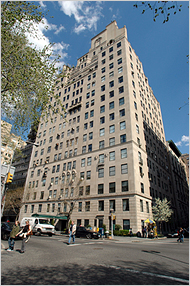 Six years ago I was walking along Park Avenue in New York City with a wise, old veteran of the mortgage wars. He pointed to a nice apartment building and commented, "Did you know that Jackie Onassis, the former wife of John F. Kennedy, used to rent an apartment in that building?" "Rent?" I asked my buddy, "Did you just say rent? Jackie Onassis was once one of the richest women in the entire world, and she was just renting? She couldn't afford to buy a condo in the building?"